









Why Your Brand Is Your Only Unfair Advantage
Building a brand independent retailers can't be out-priced or out-convenienced on
July 9, 2026

Written by
Julie Rotuno
CEO of Mid-Atlantic Packaging
Think of a brand you're loyal to. Not the cheapest one, not the most convenient one, but the one that means something to you. Chances are, it isn't really about the products they sell. It's about a feeling, and somebody, somewhere, made a deliberate choice to create it.
It's Rarely the Product. It's the Feeling.
Think about the businesses you actually go out of your way for, like the dog groomer who sends your pet home with a bag of treats, or the family-owned hardware store where someone walks the aisle with you. None of that loyalty is an accident. It's built, one small gesture at a time.
This feeling is exactly why I still remember the cloth diapers I ordered from a children's boutique when my daughter was born. Years later, it isn't the diapers themselves that I think back on. What I cherish is the memory of the handwritten note tucked inside the package. As a new mom, that small gesture meant so much, and it's why it has stayed with me ever since.
Branding isn't just a logo or a color palette. It's the sum of every feeling your business creates, and independent retailers have something no big-box store can replicate: the authentic, human ability to create those feelings on purpose. That's the only competition that actually matters. You can't out-price or out-convenience Amazon, and the good news is, you don't have to!
Customers aren't just buying a product from you. They're buying belonging, identity, and trust. The product is the vehicle, and the brand is the destination.
So ask yourself: what do people feel when they interact with your business? Is that feeling intentional, or is it happening by accident? Hold onto that question, because it's the thread that will connect everything!
Every Business Already Has a Brand
Here's something easy to miss when you're standing inside your own store every day: you already have a brand. Most businesses just haven't defined it on purpose yet. It shows up in the micro-moments, like how a staff member greets someone, the music playing in the store, the fonts on your price tags, and the bag a purchase goes home in. Each one is an emotional signal that either reinforces the story you're trying to tell, or swiftly undermines it.
Not sure what your branding is saying? Use the Stranger Test.
It's free, it takes five minutes, and it requires no consultant. If someone who'd never heard of your business walked in off the street, what story would they piece together in the first 60 seconds? Walk outside, come back in, and notice what hits you first, the way a first-time customer would.
Building the Brand Foundation: Story, Values, and Your "Only We"
Story. Where did you come from, and why does it matter? Customers connect to origin, not as biography, but as proof of purpose.
Values. What does your business stand for beyond the transaction? What would you refuse to compromise on, even if it cost you something?
Your "Only We." This is the single most powerful exercise an independent retailer can do. Finish this sentence: "We are the only business that ___."
If you can't finish it right away, that's not a failure. It's your most important homework. It isn't about what you sell. It's about who you serve and why. You don't have to be the only one selling something, you have to be the only one selling it the way you do, for the people you serve, with the conviction you bring.
Here's the gut-check: if you're one of ten boutiques in a one-mile radius, you'd better have something that sets you apart, and if you can't articulate it, your customers definitely can't do it for you.
Feeling Over Function
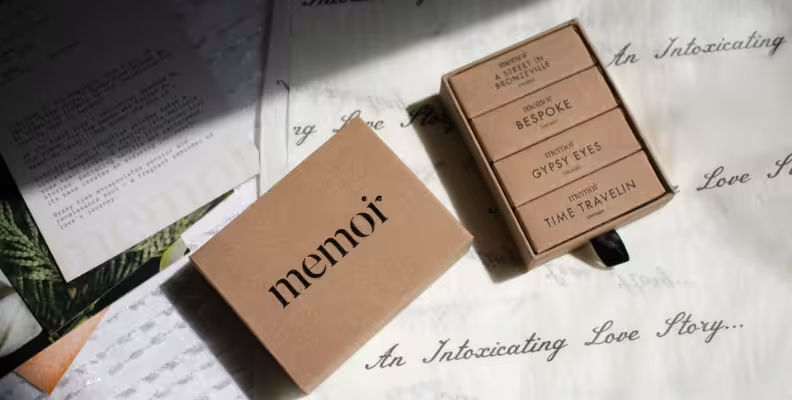
If branding is a feeling, packaging is where that feeling becomes tangible. Here's something most retailers have never stopped to question: the box, the bag, the tissue paper, basically, the thing your product gets handed to the customer in. Most people file it under overhead, a cost to minimize, a logistics problem to solve as cheaply as possible. It carries no emotional weight in their planning at all.
That assumption is worth challenging. In an increasingly digital world, the physical act of receiving something, picking it up, holding it, opening it, taking it home, has become one of the last truly intimate brand moments left in retail. It's rare precisely because so much of shopping has moved onto a screen, which means the few seconds a customer spends actually holding your product carry more emotional weight than they used to, not less. Packaging isn't an afterthought or a line-item expense: it's the emotional crescendo of the entire brand experience. And its real job isn't just protection or presentation, but to act as the physical embodiment of everything your brand has been promising all along.
Attention Looks Different Everywhere
If your business doesn't use packaging at all, the lesson still holds, it just shows up differently. A marketing consultant's "packaging" is the proposal deck, clean, on-brand, and clearly theirs before you even read the first slide. A salon's is the stylist who remembers you hate small talk, or that you always bring your kid's photo to show off before they even ask. Even a software company has one: the onboarding email that either feels like a form letter or feels like someone's genuinely glad you signed up. None of that is packaging in the literal sense, but it's the same instinct. It's proof that someone thought about you on purpose.
You Are Not the Underdog
The brands you're loyal to didn't earn that loyalty with discounts or convenience. They earned it by making you feel seen, understood, and part of something worth coming back to. That means independent retailers aren't the underdog in this story. You're the ones most capable of creating that feeling authentically, consistently, and memorably, at a scale no big-box competitor can touch. It isn't a scale problem. It's a sincerity problem, and sincerity is something algorithms have never been able to fake.
So this week, walk through your own business like a stranger would. Notice every signal it sends, your shelves, your staff, your packaging, the bag someone walks out with. Ask yourself: what do we make people feel? And is that feeling intentional?
Because in a world of faceless, identical options, the businesses that win aren't the ones competing hardest on price. They're the ones who never stopped being human in the first place.
About the Author
Julie Rotuno
CEO of Mid-Atlantic Packaging
Julie Rotuno is the second-generation CEO of Mid-Atlantic Packaging, where she helps independent retailers and product-based founders elevate their brands through strategic packaging. From custom retail bags and boxes to branded shipping materials and swag packaging for merchandise and promotional products, Julie works with businesses to turn everyday packaging into a powerful extension of their brand experience. With deep roots in the retail packaging industry, Julie believes that packaging is one of the most overlooked, yet most impactful, marketing tools a business has.
She frequently shares insights on packaging strategy, brand presentation, and how thoughtful packaging can increase perceived value, strengthen brand recognition, and create memorable unboxing experiences. Julie is passionate about helping founders understand how packaging can support both brand storytelling and business growth, whether they’re selling in boutiques, online, or through wholesale channels. Outside of the business world, Julie is a proud mom to two teenage girls and is married to an Air Force veteran and fellow entrepreneur, which has shaped her deep appreciation for resilience, leadership, and building a meaningful legacy through business.

The Latest

Heather Lillico Helps Burnt-Out Founders Rewire Their Nervous Systems
The former nutritionist burnt out building her nutrition business, and the tools that brought her back to calm now anchor her coaching for women founders.
Elizabeth Watson Helps Founders Recover Their Lost Energy

Automate Your Site with a 1-Month Free Trial
Kartra