







What Founders Should Consider Before Using AI-generated Images of Their Product
July 17, 2026
%20(2).png)
Written by
Sarah Gardner
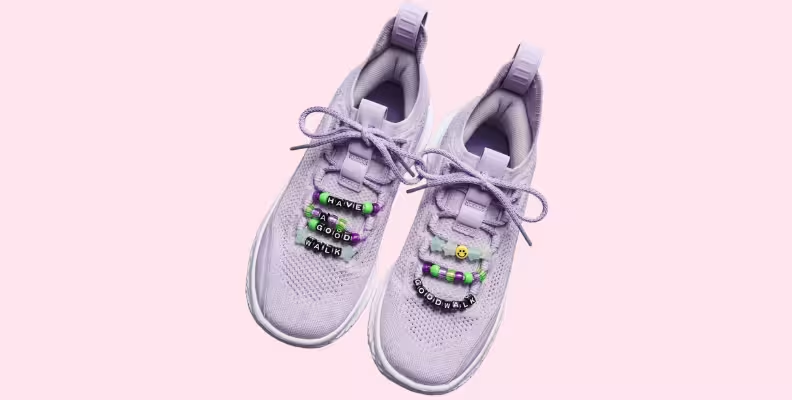
GOODWALK
Building a brand from zero is hard.
Building a brand from zero when you do not have a product, a space, customers, testimonials, or basically anything tangible to show people is…a special kind of hard.
Normally, content comes from the thing itself. You post the product. You show the space. You film the customer experience. You capture the behind-the-scenes, the happy customers, the real-time proof.
But what do you post when the physical thing does not exist yet?
In today’s world, the obvious answer is that AI can help.
AI can make realistic renderings of your product in action. It can create realistic-looking customer experiences. It can make your website look less sad and empty. It can make your brand look more established than it actually is.
I used AI on our website and socials to make our brand feel more “real.” Then I took it all down.
Which is how I found myself on ChatGPT creating images of what I imagined GOODWALK classes would look like once we opened.
For context, I am the founder of GOODWALK, a boutique walking studio opening later this summer in the Washington, DC area. Think 45-minute, instructor-led treadmill walking classes with music, lights, energy, community, and no pressure to keep up with anyone else. It is walking as fitness, but also walking as joy and connection.
The challenge is that our lease starts in August. Our studio is not ours yet. Our classes have not started. I cannot show a packed room of people walking to the beat, having the time of their lives, because that room does not exist yet.
But the images I created were pretty close to what I envisioned, so I added them to our website. A few hours later, I took them down. I just had a gut feeling that it was wrong.
After reflecting on it, I realized why. GOODWALK is all about building authentic, real, in-person community, and showing up exactly as you are without judgement or pressure.
How could I claim that the brand is about real people showing up exactly as they are, and then use fake images of fake people to represent that? It didn’t feel like a good starting point for building trust with our future customers.
So I decided not to do it. I drew a hard line in the sand for our team. No AI generated images. That decision has made building our brand harder, but it has also forced us to get clearer about what we actually had to say.
We decided to prioritize trust over perfection.
Instead of showing a finished studio, we are showing the process. Instead of showing packed classes, we are talking about why we are building them. Instead of pretending GOODWALK is already a fully formed company, we are letting people see it become one.
We are talking about why walking deserves a real home. We are posting about the problem we are solving, which is that walking is one of the most accessible, sustainable, and widely loved forms of movement, but it is still so often treated like the thing you do alone, in the corner of the gym, when you are not doing “real” fitness.
We are sharing my founder story. We are showing events, conversations, team moments, early community-building, and the values behind the business.
We are not trying to look bigger or more established than we are. We are trying to be clear about what we are building and why it matters.
And it’s working.
While the results may look small compared to established brands, they feel meaningful for a company that has not opened yet.
In our first month on Instagram, GOODWALK went from 0 to 229 followers through organic social. Across 38 pieces of content, including 14 feed posts and 24 stories, we reached 27,600 views and had 828 interactions.
Those numbers matter because they came before the space, before classes, before paid ads, and before anyone could actually take a GOODWALK class.
They came from people connecting with the idea.
You do not need to fake the proof to start building trust.
That has been the biggest lesson for me. Founders, myself included, often feel like we need a perfectly polished online presence. But if you are building something new, you probably will not have all of that at the beginning. And that does not mean you have nothing to say.
Your audience does not need perfection. They need to understand what you believe, why you are building what you are building, and most importantly, trust you. And the best way to earn that trust is not to pretend you are further along than you are. It is to invite people along for the walk.
About the Author
Sarah Gardner
GOODWALK
Sarah Gardner is the founder and CEO of GOODWALK, a walking-based fitness studio built around joy, consistency, and belonging. A former teacher, coach, and growth leader, Sarah has spent her career helping people feel capable, connected, and motivated. During COVID, she built a six-figure tutoring business from scratch, and later transitioned into EdTech sales, where she grew from an entry-level sales role into VP of Growth & Partnerships in under four years. After becoming a mom, Sarah saw firsthand how much of fitness culture is built around intensity, performance, and intimidation, and how many people are left craving movement that feels good, social, and sustainable.
She founded GOODWALK to create a different kind of fitness company, where belonging matters more than performance.

The Latest
Heather Lillico Helps Burnt-Out Founders Rewire Their Nervous Systems
The former nutritionist burnt out building her nutrition business, and the tools that brought her back to calm now anchor her coaching for women founders.
Elizabeth Watson Helps Founders Recover Their Lost Energy

Automate Your Site with a 1-Month Free Trial
Kartra