













How Dr. Annie Graziani Built Sovera, a Workforce Intelligence Firm Making the Financial Case for Treating People Like Multipliers
May 27, 2026

Written by
There are consultants who help organizations talk about their people differently. There are researchers who study why workplaces fail. Dr. Annie Graziani is both, and Sovera is the company she built because the conversation between those two roles could not happen from inside any single corporation.
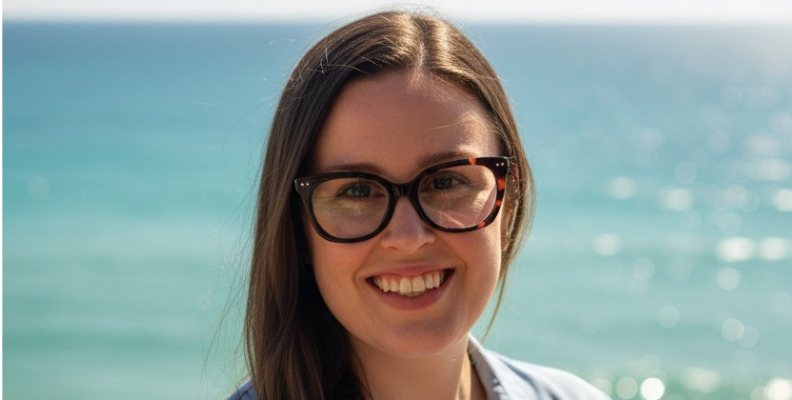
Dr. Annie Graziani is the CEO and Founder of Sovera, a workforce intelligence and organizational architecture consulting firm built on a single core idea: people and profits are multipliers, not tradeoffs. Sovera helps organizations build workforce systems where human sustainability and organizational performance reinforce each other, improving retention, execution capacity, and long-term business resilience.
"I'm a firm believer that when organizations take care of their people, the people take care of the organization."
That sentence sounds simple. The body of work underneath it, two decades inside global brands, a Penn doctorate, two original theoretical contributions to the field of organizational design, is what makes it actionable.
The Operator Who Became a Researcher Who Became a Founder
Most consultants in workforce strategy are either operators without research or researchers without operating experience. Annie became both.
Before Sovera, she spent more than twenty years in executive leadership and consulting roles across fashion, retail, operations, and digital transformation. The brands include LVMH, Marc Jacobs, Tapestry/Coach, Vera Bradley, FILA, Frette, Patagonia, Sea to Summit, 5.11 Tactical, and Zimmermann. She ran operations. She led large-scale technology transformations. As COO, she sat in the executive seat where the decisions about hours, headcount, policy, and culture were actually made.
What she saw inside those rooms eventually drove her to the University of Pennsylvania's Graduate School of Education for doctoral research focused on work-life integration, the history of organizational structures, and the relationship between workforce wellbeing and measurable business outcomes.
"After two decades working inside the corporate system, I saw the same pattern repeated," Annie says. "Companies treating their best people as expendable line items, then panicking when those people left. My doctoral research at Penn surfaced what was actually happening underneath."
The Entrepreneur Who Refused the Identity, Until She Could Not
Annie comes from three generations of entrepreneurs on both sides of her family. On some level she always knew there was a good chance she would see the world through that lens.
"However, I rejected the notion for the longest time," she says. "I built my career inside large organizations and loved the operator's seat."
Still, she always thought like a builder.
"Questioning defaults, redesigning broken systems, and challenged why processes existed in the form they took, in an effort to optimize efficiencies without losing the people in the process."
Eventually the case she was building, for treating workforce architecture as a structural business problem, outgrew what any single company could hold.
"Entrepreneurship eventually found me when the case I was building outgrew what I could do from inside any one company," she says. "It turns out the family pattern was right all along. I just took the long way to stepping into the space."
The Customer Sovera Was Built To Serve
Sovera is precise about who it serves.
"Growth-stage and transformation-stage organizations, $10M to $1B+ in revenue, that need evidence-based workforce architecture redesign to reduce attrition and restore high-performer productivity," Annie says.
The clients are C-suite decision-makers, PE firms, portfolio companies, and enterprise and mid-market businesses experiencing burnout, disengagement, retention instability, and execution friction. The common signal is recognizable.
"They've tried leadership training, engagement surveys, wellness programs, and flexibility policies, and they're still losing the people they can't afford to lose," she says. "They're ready to stop treating symptoms and start redesigning the architecture."
The Premium, Counterintuitive Launch Playbook
Sovera publicly launched in April 2026 after a year of deliberate foundation building, including a beta cohort of five executive coaching clients who tested the methodologies in real conditions alongside qualitative and quantitative research that supported the instinct with data.
The marketing strategy has been intentionally counterintuitive for a founder launch.
"No paid ads, very little Instagram, leveraging my 10K+ network to support lead generation," Annie says. "I began nearly two years ago with coordinated LinkedIn thought leadership from my personal profile, strategic posts inside professional communities, joining communities including the Penn CLO alumni board, Entreprenista, Women in Retail Leadership Circle, and Retail Women in Tech."
The results have outpaced the plan.
"The content cut through harder than expected," she says. "The financial argument for wellbeing is landing with CFO-fluent buyers in ways generic culture content doesn't, and we have a flush pipeline of hot and warm leads ready to engage this summer."
The Research That Reframes the Workplace Conversation
Annie's doctorate produced two original theoretical contributions that now sit underneath Sovera's methodology.
The first is the Importance-Effectiveness Gap. Every single workplace support category she studied showed organizations falling short of what they claimed to offer. The gap between intention and delivery is measurable, repeatable, and largely invisible inside the organizations themselves.
The second is Boundary Control Authority. Integration quality, she found, is determined by who controls the boundary between work and the rest of life, not by how permeable that boundary is.
"That research is what allows Sovera to make the case in the language each side can trust," Annie says. "The C-suite's fiduciary responsibility to shareholders and stakeholders alike, argued through ROI, and the workforce's human experience of the workplace, with evidence and methodologies to support it all."
The Year That Changed Everything
The past year is, in Annie's words, life-changing.
She launched Sovera in April 2026 after a year of deliberate foundation building. She completed her doctorate at Penn. She structured the Talent and Culture Intelligence Program, Sovera's flagship 12-week workforce intelligence engagement, into a productized, repeatable offering. She built a curated practitioner bench so Sovera operates as a collective of aligned, credentialed coaches and consultants rather than a solo practice. She launched the Forces of Change podcast and was invited as a guest on The Regulated CEO, Startups in Stilettos, and other leadership podcasts.
She reactivated her Substack with an essay series. She built out a proprietary IP portfolio that includes the WLI-D diagnostic, the Entirely You Framework, the 3x3x3 Quarterly System, and the Sovereign Leadership Model, positioning Sovera for a SaaS, certification, and licensing roadmap.
She also personally invested nearly $45K into the business and built it without outside capital so far.
The Accomplishment That Means the Most
When asked what she is most proud of, Annie's answer is not the doctorate or the launch.
"Having the courage to trust this community and trusting my instinct that this was the community to trust," she says. "That decision has compounded beyond expectations."
She found her thought partners in Entreprenista. Emily Paulsen on brand building. Lauren Bercuson on legal. Natasha Walstra on personal branding. Lisa Cherfane on marketing. Jade Pruett on SEO, AIO, and GEO.
"It's gone faster than planned, because of their support."
The Mamaprenista Discipline
Annie is a mother and the reason Sovera exists.
"They are the reason that Sovera exists," she says of her kids. "It's my own reality reflected by those who are in my boat. The way I navigate it is the same way I help organizations navigate it. Design the structure. Own your boundary control authority. Stop trying to keep your caregiving life invisible at work and your work life invisible at home."
Her practical model is concrete.
"I work through acutely focused jam sessions while my children are at school for a solid 5-6 hours. I always have my must-do list and those are the top priority for the day. After that, I fill in what I can including home responsibilities. That's plenty for a meaningful day's work and an enormous amount of cognitive load to feel good about turning it off after that."
Weekends are protected for rest.
"Rest on the weekends is critical."
The advice she gives other founder mothers is short and exact.
"Kids don't need a perfect entrepreneur for a mother. They need a present one with a point of view. Same goes for workplace teams."
Hiring for Alignment, Not Just Capability
When Annie hires, she leads with two questions.
"Tell me how you take care of yourself outside of work, and what happens to your work when you don't. What lights you up? What is your ambition as it relates to this organization?"
"These tell me everything I need to know about what that person values so we can both be held accountable to those important answers," she says. "This tells me whether they have self-awareness, whether they understand their own sustainability, and whether they recognize the connection between the two and that relationship to the work we are doing."
"Skill gaps are trainable. Vision and values misalignment are not."
The same logic shapes how she builds Sovera's practitioner bench. She selects for shared philosophy, not just credentials.
The Tools That Run a Premium Practice
Right now Annie's must-have app is LinkedIn.
"That is where Sovera exists through my personal brand and the business brand. It's where the thought leadership is activated and reaching the right audiences."
Her favorite business tool is HubSpot.
"It runs the backbone of Sovera. CRM, pipeline segmentation, newsletter delivery, nurture sequences, and lead scoring across all three of our channels. What I love most is that Lisa Cherfane and I can both toy around in there to build a sophisticated, automated system that still feels personal at every touchpoint. The cold work gets automated while the warm work stays human."
That principle, automate the cold work, keep the warm work human, scales across the rest of how Sovera operates.
The 3x3x3 Quarterly System
Annie's top productivity tip is the framework she built.
"Three priorities, within three months, held accountable by three partners who care about these successes," she says. "This framework optimizes contribution and forces me to disqualify and make choices about what falls outside of the objectives at hand."
The companion tip is the one she keeps coming back to.
"Protect your boundary control authority. The quality of your output isn't about how many hours you give. It's about who decides when and how those hours get spent. Reclaim that variable and everything else gets easier. Stop living under the expectations of others."
That sentence is also her doctoral thesis in plain language.
The Integration Frame That Replaces Balance
Annie's view on work-life balance is informed by her own research.
"Balance is the wrong frame because it implies work and life are competing weights to keep level, which is exhausting and never achievable or sustainable. Life gets real and throws wrenches constantly. Integration or harmony is the frame."
Her research found that the people who integrate well are not the ones with the most flexibility.
"They're the ones with the most authority over their own boundaries, treated like trusted adults," she says. "It is autonomy, flexibility, and trust that afford modern contributors to design their life structures, own their variables, mitigate the unknowns, and stop asking permission to live a whole life."
She is direct about the bet she made on herself.
"I left conventional structures to be an example of what's doable, however risky that decision was at the time."
Recovery as Infrastructure
Annie's approach to burnout is structural.
"I treat recovery as infrastructure, not reward," she says. "Sleep, movement, quiet thinking time, and unscheduled white space on my calendar aren't earned at the end of a hard week. They're the conditions that make the most demanding week possible."
Her doctoral research is literally on this topic.
"Burnout isn't a personal failing, it's a structural one. So I structure for sustainability."
She also defends her time directly.
"I say no fast and without explanation when something isn't aligned. I'm a believer that no is a complete sentence and a productivity strategy."
The Three Things She Would Tell Newer Founders
Annie's advice is condensed and pointed.
"First, clarity is a discipline, not a deliverable. Sharpen it every conversation. Socialize your ideas. Collect that data. Continue to refine."
"Second, choose your community with the same rigor you choose your clients. The right community compounds and everything you need can be found there."
"Third and most importantly, don't soften the thing that makes you different to make it easier to buy. Don't dilute it. The work isn't to be understood by everyone. It's to be unmistakable to the right ones."
What's Next for Sovera
The roadmap has three priorities.
"First, scaling Sovera's B2B engagements across PE-backed portfolios, professional services firms, and growth-stage organizations where retention is an existential business problem," Annie says.
"Second, productizing the WLI-D into a licensable diagnostic platform so the methodology scales beyond any one consultant, and Sovera becomes the standard infrastructure organizations and individuals use to measure workforce architecture risk and human engagement."
"Third, launching the D2C practice by productizing the Entirely You framework into cohorts and courses that support individuals seeking agency over the design of their own lives, beginning with the October 2026 flagship cohort program."
Underneath all of it is a longer arc.
"Build Sovera into a workforce intelligence company with proprietary data, defensible IP, and a category-defining point of view on what work should cost, and what it should return."
A forthcoming book on human purpose, contribution, and the elevation of human potential is also in progress, alongside continued academic journal publications. The mission underneath everything is, in Annie's words, "to rehumanize the workforce and elevate society and human potential for the greater good of all."
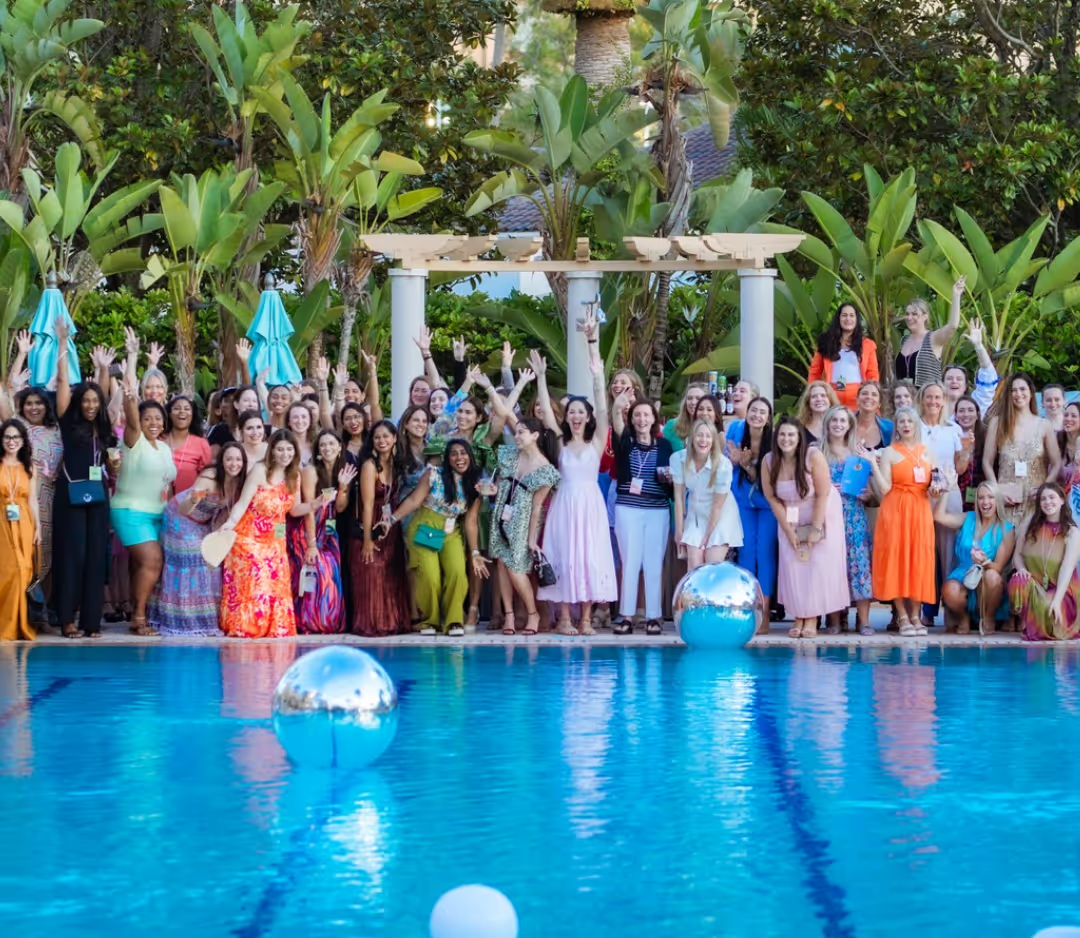
If Annie's approach to building a research-anchored, financially fluent workforce intelligence firm resonates, the Entreprenista League is a community of women founders who value connection, shared experience, and practical business insight as they grow.
About the Author
Entreprenista League

The Latest
Heather Lillico Helps Burnt-Out Founders Rewire Their Nervous Systems
The former nutritionist burnt out building her nutrition business, and the tools that brought her back to calm now anchor her coaching for women founders.

Elizabeth Watson Helps Founders Recover Their Lost Energy

Automate Your Site with a 1-Month Free Trial
Kartra