









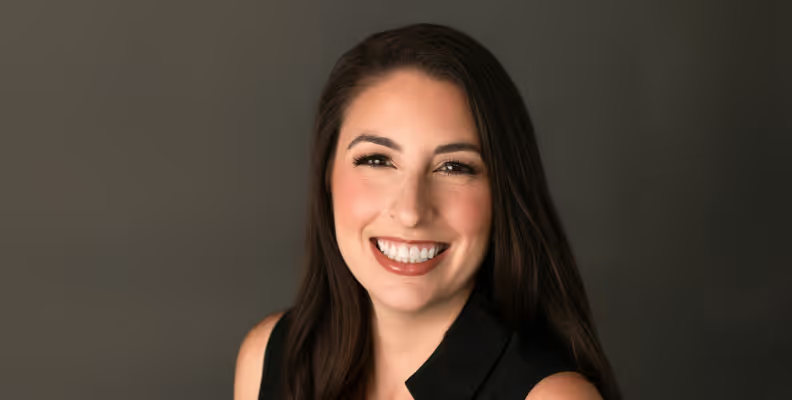
How Theresa Mirell Built BlissfullyBalanced to Bring Cash Flow Clarity to Wedding Planning
May 7, 2026

Written by
Meet Theresa Mirell, founder of BlissfullyBalanced, a financial planning and cash flow platform for weddings that helps couples move beyond static budgets and understand what is due, when, from whom, and where the gaps are. Theresa spent her career in consulting, enterprise software, and healthcare, most recently as SVP of Business Enablement at a public healthcare company, before turning that systems-thinking mindset toward one of the first major financial moments many people share with a partner.
The hook for Theresa's product came from a single conversation while planning her own wedding. Her dad told her he was happy to contribute whenever she needed it. Her mom asked a different question: when would this actually be most helpful? That question changed how she saw the entire process. The challenge was not how much, it was when, and the tools available answered everything except that. So she built one.
Please share a brief introduction and your business:
I've spent most of my career working at the intersection of technology, data, and complex systems, often in environments that weren't built for clarity.
Today, I'm building BlissfullyBalanced, a financial planning and cash flow platform for weddings. We help couples move beyond static budgets and understand what's due, when, from whom, and where the gaps are.
Most wedding tools answer what to plan. We focus on what's due, when, and whether you're actually ready.
Weddings are one of the first major financial planning moments many people go through together, yet the tools in the market largely ignore timing. BlissfullyBalanced brings structure, visibility, and confidence to that process so couples can spend less time managing financial stress and more time being present in the experience.
Take us back to when you launched. What was your marketing strategy?
Early on, the focus was on education rather than promotion.
We leaned into content that helped people understand the difference between budgeting and cash flow, and why timing, not just totals, is what actually creates stress in wedding planning.
That approach resonated quickly. We weren't introducing a new idea. We were giving people language for a problem they already felt.
What didn't go as planned was how long it takes to translate that awareness into product behavior. It reinforced that understanding a problem and changing behavior are two very different steps.
Did you always know you wanted to be an entrepreneur?
Not explicitly.
I've always been drawn to building and improving systems, but I spent most of my career doing that inside organizations rather than starting something from scratch.
This is the first time I've applied that instinct to something of my own, and it has been both more challenging and more energizing than I expected.
Do you have a co-founder?
I'm currently building BlissfullyBalanced as a solo founder.
That has meant being very intentional about where I spend my time and how I make decisions. It also reinforces the importance of surrounding yourself with the right advisors and community.
You don't need a co-founder to build something meaningful, but you do need perspective.
What accomplishments are you the most proud of to date in your business?
I'm most proud of how consistently the problem resonates.
When users engage with payment timelines and immediately say, "This is exactly what I've been missing," it's a strong signal that we are solving something real.
In a crowded category, clarity is a differentiator. And we've been very intentional about earning that.
What is one thing you wish you had known when you started your Entreprenista journey?
How long it can take for clarity to compound.
In the early stages, it can feel like you're circling the problem. Messaging shifts, product evolves, nothing feels fully locked.
But that iteration is the work.
Clarity doesn't come from thinking longer. It comes from building, observing, and refining over time.
What did you do before starting your own business?
Before starting BlissfullyBalanced, I spent my career in consulting, enterprise software, and healthcare, most recently as SVP of Business Enablement at a public healthcare company.
My role spanned IT, data, security, and program management, with a focus on bringing clarity and structure to complex, fragmented systems. I also served as Chief of Staff to the CEO, which gave me a front-row view into how organizations actually operate and make decisions at scale.
In many ways, I've always been doing the same work. Turning complexity into something people can actually navigate.
What made you take the leap to start your own business?
The idea for BlissfullyBalanced started with a broader belief about how we support people through major life moments.
Some of the most meaningful transitions in life, weddings, starting a family, caregiving, are also the moments where financial and logistical complexity shows up all at once. And yet, they are often the least supported from a systems and tools perspective.
I've spent years working in complex systems, and I kept noticing the same gap. We have strong tools and frameworks when operating in structured environments, but far fewer for the moments in life where things are emotional, dynamic, and often happening for the first time.
That became very real when I was planning my own wedding.
At one point, my dad told me he was happy to contribute whenever I needed it. My mom asked a different question. "When would this actually be most helpful?"
That moment changed how I thought about the entire process.
The challenge wasn't just how much money was involved. It was when it was needed.
When I looked at the tools available, nothing was built to answer that clearly. That gap between having a budget and understanding your cash flow is what ultimately pushed me to build something myself.
Do you have any recent wins?
Over the past year, we've taken BlissfullyBalanced from concept to a working product and built early momentum with users actively engaging with the platform.
Equally important has been sharpening how we talk about the problem.
The shift is subtle, but powerful. Not budgeting. Cash flow. Not totals. Timing.
That clarity has created much stronger alignment with how people actually experience financial stress during wedding planning.
Who are your customers?
Our customers are primarily engaged couples, often the person taking the lead on planning, who want to feel in control of their wedding finances without becoming full-time project managers.
We also resonate strongly with financially-minded planners. People who naturally think in systems but have never been given a tool that reflects how money actually flows in real life.
Because the stress is rarely about the total. It is about timing, coordination, and not wanting to get it wrong.
What's your top productivity tip?
Clarity beats volume.
Most productivity advice focuses on how to do more. In reality, the highest leverage comes from knowing what actually matters and being willing to ignore the rest.
I try to define one or two things that truly move the business forward each week. If those get done, it was a productive week.
What's your favorite business tool?
Right now, anything that helps shorten the loop between idea and feedback.
In early-stage companies, speed of learning is everything. Tools that make it easier to test, observe, and iterate quickly are far more valuable than ones that optimize for scale too early.
What's your approach to work-life balance?
I think more in terms of alignment than balance.
There are seasons where work demands more, and others where life does. Trying to keep everything perfectly balanced at all times is usually unrealistic.
What matters more is whether what I'm spending time on actually reflects my priorities. When that is true, the tradeoffs feel more intentional.
What advice do you have for aspiring Entreprenistas?
Start with a problem that actually bothers you.
Not something that seems interesting or marketable, but something that you genuinely want solved. You'll need that level of conviction when things get harder than expected.
The goal isn't to have everything figured out at the start. It's to stay close to the problem long enough to get to something real.
What's next for your business? What can we expect to see over the next few years?
In the near term, the focus is on continuing to refine the product experience and deepen the value we provide around financial clarity and coordination during wedding planning. Longer term, I see this expanding beyond weddings into a broader platform that supports women through major life transitions. Moments that are emotionally significant but often financially and logistically complex. These are moments where people are expected to figure it out as they go. And often, they are doing it for the first time. The goal is to bring clarity and confidence to those experiences in a way that does not exist today.
Theresa's story is a reminder that some of the most useful products start with a single question a parent asks at exactly the right moment, and that founders who have spent careers turning complexity into clarity for big organizations can do the same thing for the most personal moments of someone's life. We are so glad to have her in the Entreprenista community and cannot wait to watch BlissfullyBalanced continue to grow.
Want to connect with founders like Theresa? Visit the Entreprenista League to explore our community and discover more stories of women building businesses that truly matter.
About the Author
Entreprenista League

The Latest
Heather Lillico Helps Burnt-Out Founders Rewire Their Nervous Systems
The former nutritionist burnt out building her nutrition business, and the tools that brought her back to calm now anchor her coaching for women founders.

Elizabeth Watson Helps Founders Recover Their Lost Energy

Automate Your Site with a 1-Month Free Trial
Kartra