













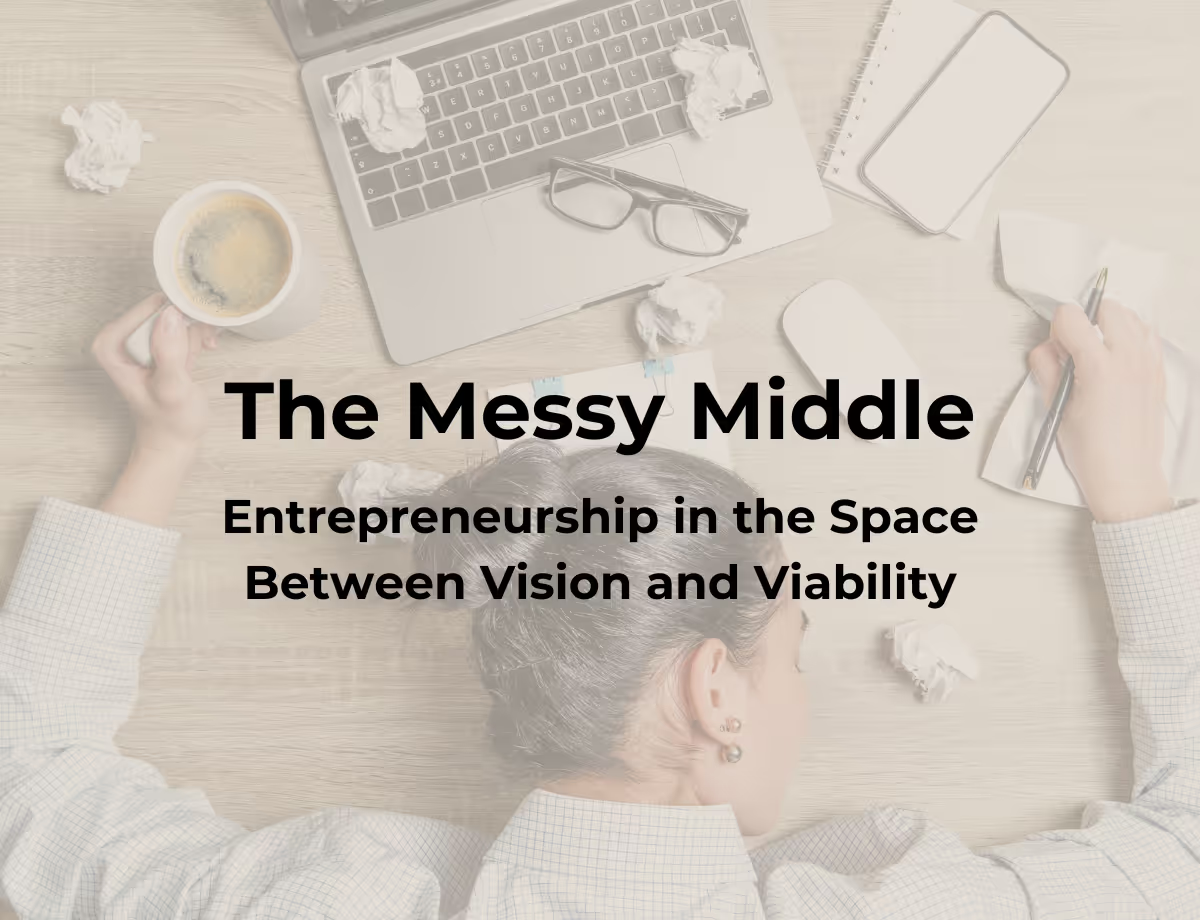
The Messy Middle: Entrepreneurship in the Space Between Vision and Viability
February 18, 2026

Written by
Danielle Ruess
Founder of Eonian
It’s amazing how fast you learn when you dive into entrepreneurship; in the early days you are wearing all hats, making all decisions, and operating everyday between euphoria and complete exhaustion. Yet, the culture of entrepreneurship tends to spotlight mostly two extremes: the breakout success or the quiet shutdown. Headlines usually focus on celebrating funding rounds, acquisitions, and viral launches. The middle of that journey is largely invisible.
But most founders I meet, including myself, aren’t really failing, but they’re not winning —at least not yet. They’re operating in that ‘messy middle’ — that space between a compelling vision and proven business viability. It’s the stage where revenue is inconsistent, breakeven is still over the horizon, profitability feels just out of reach, and every decision feels consequential.
What It Actually Feels Like Before Profitability
The messy middle is not glamorous, at all. I’m speaking purely from a product business owner perspective, but I know B2B Services all too well because that’s the space I came from. You can see engagement growing, you’ve finally had a few nice media hits, you see your repeat customers growing and yet, you still aren’t at breakeven or profitable. You can be improving month over month and still feel like a failure. You can be trying everything to beat the algorithm, and still not have enough data to feel confident in your decision.
This stage feels like a test of your entire identity. As someone who spent 26 years in corporate, validation is something that you get frequently: performance reviews, promotions, bonuses, and even external recognition. In early-stage entrepreneurship, validation is ambiguous — your metrics are constantly fluctuating, growth is nonlinear and well, you can fall victim to the sound track playing in your head. You must hold yourself steady in the absence of proof.
That stress —between what you see and what you know is possible—is psychologically demanding and can be exhausting.
The Psychological Toll of Delayed Validation
Many founders in this phase that I’ve spoken to often internalize slower traction as personal failure. Myself included. But, speaking to founders who have made it through the messy middle – either to a big exit or just becoming profitable enough to have the quality of life that they wanted in the first place – that assumption is flawed.
It is a fact that most businesses take longer than expected to reach profitability, especially those bootstrapping. Cash flow constraints, channel testing, pricing refinement, and audience education all extend timelines.
But, the emotional strain feels heavier sometimes because of the visibility of others’ highlight reels. Social media compresses timelines and exaggerates outcomes, distorting expectations. Yet, when you really read most of the larger success stories, the honest founders will say ‘that they started 10 years ago’ and you may have only recently become aware of the brand, so it feels accelerated.
There are many things that I wish I knew two years ago but if I can share anything that will help, it’s this; be wary of over-correcting too quickly, abandoning a viable strategy prematurely or clinging to an idea solely out of ego. Leading through the messy middle requires resisting all of that noise.
Making Smart Decisions When Metrics Are Incomplete
In the early days, you can’t rely on the sparse data you have to make decisions. If any of you are operating on Shopify - the analytics can make you feel incompetent if you try to track weekly. You may have early conversion numbers but not enough scale for statistical certainty. You may see traction in one channel but not know whether it’s repeatable. You may believe in your differentiation but lack sufficient market awareness.
What can help? Putting on your ‘scenario’ hat and looking as objectively as possible at what little data you do have and looking for signals in that noise. Those signals could be very small patterns that are emerging. And then? You have to trust your experience and your own judgement.
Many founders with prior leadership experience often underestimate the value of intuition. Data matters, yes, it is critical, but in the early stages, it is often directional, not definitive.
There is no way to completely eliminate risks; but it’s more about taking intelligent, contained bets. Pilot before scaling - many platforms offer free or trial versions so you can test before committing. And, if you see improvement, then you can increase investment.
Staying Mission-Driven Without Standing on Denial
I was having a venting session with another ‘messy middle’ entrepreneur and we said there should be a t-shirt that says ‘There is a fine line between conviction and denial’.
We all started our businesses with a mission. And, we must continuously question our own assumptions. Is the problem we are solving real for the intended audience? Is the differentiation meaningful? Will customers pay? Am I adjusting based on evidence, or just defending my original hypothesis?
Conviction is powerful. Denial is expensive. The messy middle demands intellectual honesty. If something is not working, refine it, if messaging is unclear, simplify it, if a channel consistently underperforms, pause it.
By keeping the ‘reason for being’ front and center, staying open to avenues that were not even in the original plan, and not becoming attached to one specific tactic that felt like the big breakthrough, the business will have its ups and downs, but stability will come.
Why the Messy Middle Matters More Than the Beginning
Many entrepreneurs are almost giddy those first six months - you have the plan, you are building and executing and you are so excited about the possibilities. And then you get past your first year and…reality sets in. But this is where more experienced entrepreneurs tell me the real learning starts. Capital efficiency, sharpening of messaging and tactics, product-market fit becomes more apparent and resilience becomes operational.
This is also the point where the community you surround yourself with matters the most. If you are reading this and you haven’t found an entrepreneurs group or anyone to learn from or chat with, you are doing yourself a disservice. I spent more time sifting through Fiver and other platforms to find help, when the best resources have come from the Entreprenista League. The members vary from not-even-launched to multiple businesses and exists, to large national brand owners you have all heard of. Being part of a community that normalizes every stage of entrepreneurship—rather than glamorizing overnight success—can reduce much of the anxiety and doubt we all face. No matter what community you choose, make sure you find a space for honest conversations about margins, cash flow, marketing and balancing your life.
The messy middle is not a holding pattern before success happens. It is the work, the business and the heart of what’s to come. And leaning into this space, letting yourself be uncomfortable, kindly deflecting all of the questions from well-meaning friends and family who don’t understand that you aren’t failing, but building, is what ultimately will help you continue to achieve the outcomes you want.
About the Author
Danielle Ruess
Founder of Eonian
After 26 years in the corporate world, Danielle founded Eonian Skincare, driven by her personal journey to address skincare challenges she encountered after turning 40. Her search for effective solutions led her to collaborate with dermatologists, functional physicians, estheticians, and plastic surgeons. Frustrated by products that over-promised and under-delivered, she recognized that many formulations lack ingredients truly beneficial for maturing skin.
Eonian Skincare isn’t about chasing youth—it’s about fostering skin health. Every product is thoughtfully crafted with clean, natural ingredients, and are vegan, cruelty-free, and proudly made in the USA. Danielle’s mission is to provide skincare that works in harmony with the skin’s natural processes, offering realistic results for real people.

The Latest
Heather Lillico Helps Burnt-Out Founders Rewire Their Nervous Systems
The former nutritionist burnt out building her nutrition business, and the tools that brought her back to calm now anchor her coaching for women founders.

Elizabeth Watson Helps Founders Recover Their Lost Energy

Automate Your Site with a 1-Month Free Trial
Kartra