













.avif)
How to Know If Your Brand Is Actually Media-Ready
March 27, 2026
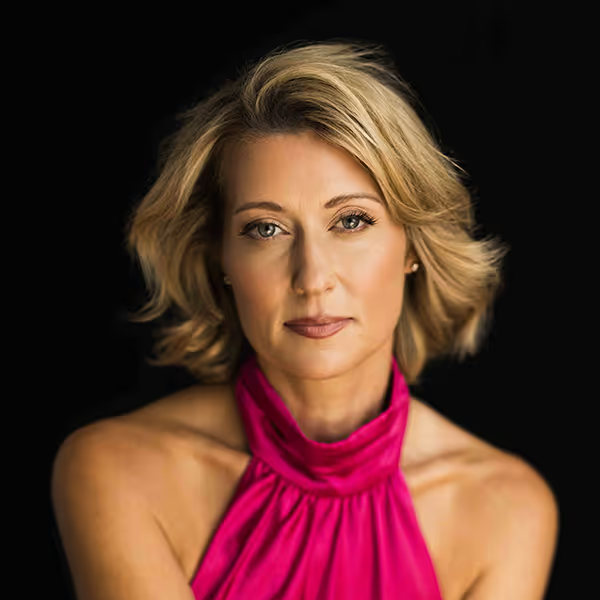
Written by
KJ Blattenbauer
Hearsay PR
One of the most common assumptions founders make about public relations is that media coverage comes later.
Later, when revenue is higher. Later, when the team is bigger. Later, when the brand feels more established.
But editors aren’t evaluating whether a business looks impressive from the outside. They’re evaluating whether someone can help explain what’s happening right now.
Media readiness has far less to do with scale than most founders expect. It has everything to do with clarity.
Media Coverage Isn’t About Promotion
This is the part many founders don’t realize until they’ve already tried pitching.
Editors aren’t looking for businesses to promote. They’re looking for people who can contribute meaningfully to conversations their audience is already paying attention to.
That conversation might be:
- a shift inside your industry
- a pattern you’re seeing with clients
- a decision founders are struggling to make
- a misconception that keeps circulating
When you can explain something others are still trying to understand, you become useful to media.
Usefulness is what makes someone media ready.
Audience Size Isn’t the Signal Editors Use
Many founders assume they need a larger platform before reaching out to media.
In practice, editors rarely ask how many followers someone has. They care whether the person being quoted understands what’s changing and can explain why it matters.
Media-ready founders tend to show three signals clearly:
- they know what they want to be known for
- they explain the same category of problem consistently
- they bring a perspective instead of a résumé
Those signals make editors’ decisions easier.
And when decisions are easier, coverage becomes more likely.
The Timing Question Most Founders Are Actually Asking
Often the question isn’t whether a founder is qualified. It’s whether the timing makes sense.
A strong business can still be difficult to place if its expertise isn’t connected to something people are actively navigating right now.
Media runs on relevance.
When your work intersects with larger conversations already happening—economic shifts, hiring challenges, consumer behavior changes, industry transitions—your perspective becomes easier to include in coverage.
Media readiness often comes from intersection, not achievement.
Three Questions That Reveal Whether You’re Ready for Press
Before beginning outreach, I often suggest founders test their positioning with three simple questions.
If someone mentioned your name in a room, what idea would immediately follow it?
If the answer is broad, like business, marketing, leadership, entrepreneurship, your positioning may still be too general for media to reinforce.
Recognition grows when expertise is specific.
Are you explaining what’s changing, or just what you do?
Editors include people who interpret patterns. Not just people who describe services.
Perspective creates placement.
Does your insight connect to something bigger than your company?
Media rarely covers businesses in isolation. It covers shifts, decisions, trends, and questions audiences are already trying to navigate.
When your expertise helps explain those shifts, coverage becomes far more natural.
What Media-Ready Founders Do Differently
Media-ready founders usually aren’t louder than everyone else in their industry.
They’re clearer about the role they want to play inside it.
They explain the same category of problem across platforms. They contribute insight instead of introductions. And they understand how their experience fits into conversations already happening around them.
That clarity makes editors’ decisions easier.
And easier decisions lead to more opportunities.
The Shift Most Founders Don’t Expect
Media readiness isn’t about whether your business is impressive. It’s about whether your perspective helps explain something people are already trying to understand.
When founders get clear about what they want to be known for, and how their insight contributes to larger conversations already underway, media opportunities stop feeling unpredictable.
They start feeling aligned.
And that’s usually the moment PR begins working the way it’s supposed to.
About the Author
KJ Blattenbauer
Hearsay PR
KJ Blattenbauer is a powerhouse publicist, author, and visibility strategist who helps founders move from “best-kept secret” to in-demand authority. With nearly three decades of PR experience, she’s known for her sharp messaging, no-nonsense strategy, and ability to turn a founder’s story into press that actually drives revenue. As the founder of Hearsay PR and the author of Pitchworthy, KJ has shaped national narratives for brands across business, lifestyle, and leadership.
Her work blends editorial storytelling with actionable strategy, giving women entrepreneurs the clarity, confidence, and media presence they need to grow on their own terms. A trusted voice inside multiple founder communities, KJ is committed to making visibility feel strategic—not stressful—and believes every woman has a story worthy of being recognized.

The Latest
Heather Lillico Helps Burnt-Out Founders Rewire Their Nervous Systems
The former nutritionist burnt out building her nutrition business, and the tools that brought her back to calm now anchor her coaching for women founders.
Elizabeth Watson Helps Founders Recover Their Lost Energy

Automate Your Site with a 1-Month Free Trial
Kartra